🗓 Released Aug 26, 2025
⌛343 days estimated until next model(387 of 730 days through last cycle)
💰
Deals Advice
neutralEarly in cycle — full price expected
Early in cycle — full price expected
| Model/Config | Build Volume | Speed | Multicolor | Best For |
|---|---|---|---|---|
| H2S (standalone) | 340×320×340 mm | 1000 mm/s | No (AMS 2 Pro sold separately) | Large-format single-color professional printing. |
| H2S AMS Combo | 340×320×340 mm | 1000 mm/s | 4 colors (AMS 2 Pro included, expandable to 24) | Large-format multicolor professional printing. |
Key strengths
The H2S offers 220% the print volume of the X1C. At 1000 mm/s it is also Bambu's fastest printer, making it the top choice for high-throughput professional production.
The enclosed chamber with active heating handles the full engineering filament spectrum — ABS, ASA, PA, PA-CF, PC, and PPS — with consistent results across the full build plate.
The H2S supports up to 12 AMS units (4 AMS 2 Pro + 8 AMS HT), enabling 24-filament printing for large-format multicolor production.
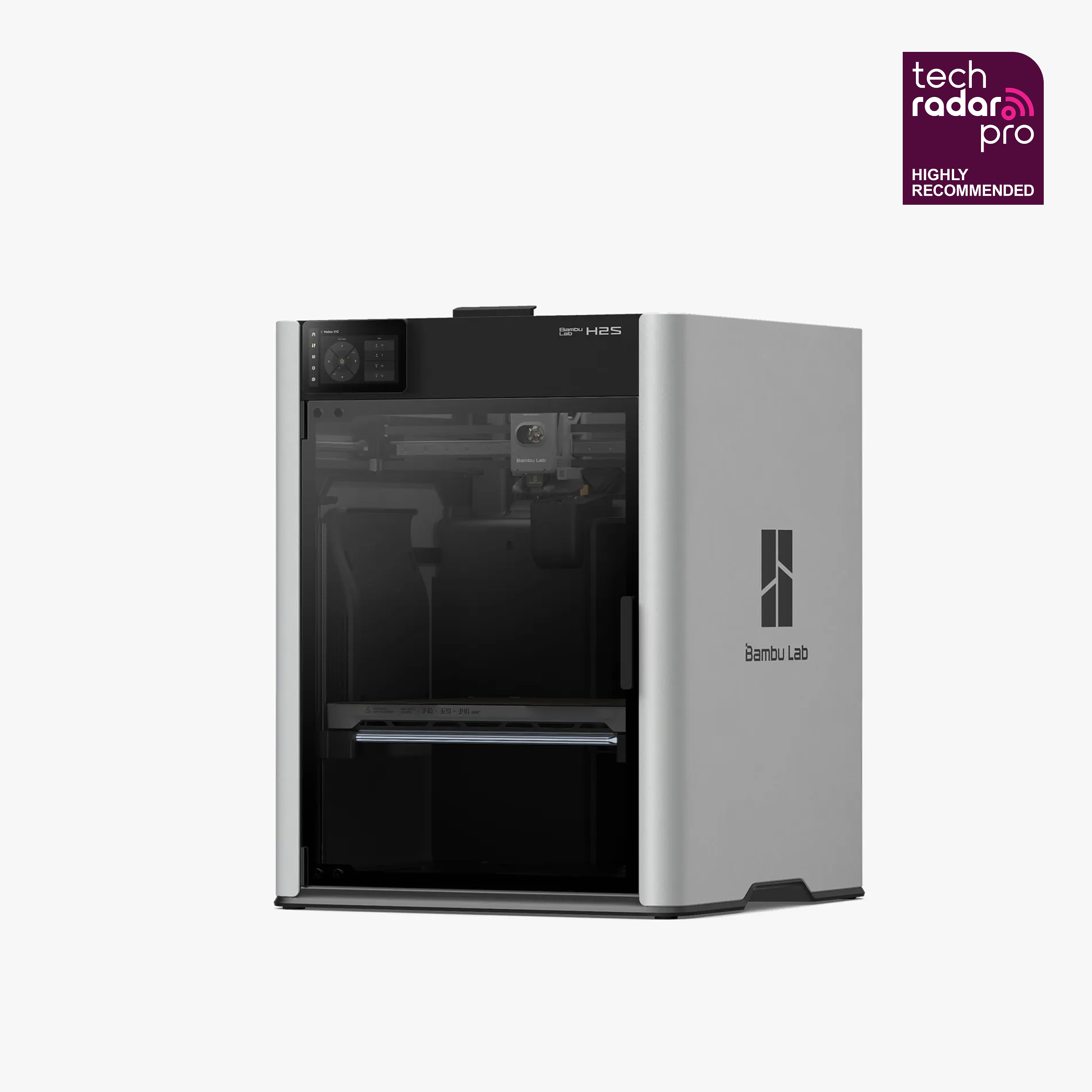
The Bambu Lab H2S, announced August 26, 2025, is Bambu's largest single-nozzle printer — sold alongside the dual-nozzle H2D with a 340×320×340 mm build volume (220% the volume of the X1C), 1000 mm/s peak speed, and active 65°C chamber heating. Unlike the dual-nozzle H2D, the H2S uses AMS 2 Pro for multicolor printing, supporting up to 24 filaments across multiple AMS units.
The H2S has a 220% larger build volume (340×320×340 vs 256×256×256 mm) and prints at 1000 mm/s vs the X1C's 500 mm/s. The X1C adds LiDAR first-layer scanning and AI spaghetti detection — useful for unattended printing on complex jobs. For maximum volume and speed, the H2S. For the best monitoring and reliability on high-value prints, the X1C.
No — the H2S is single-nozzle. The 'S' in H2S stands for single. It sits alongside the dual-nozzle H2D with a single high-speed nozzle and AMS 2 Pro compatibility for multicolor. If you specifically need dual-nozzle printing (for true simultaneous two-material output), look at the Bambu H2D or the toolchanger H2C instead.
The H2D uses dual nozzles printing simultaneously — ideal for soluble supports and no-waste two-material prints — and remains an active model. The H2S uses a single high-performance nozzle at 1000 mm/s with AMS multicolor support. The H2S is larger and faster for most high-volume single-material workflows; if true dual-extrusion is essential, the H2D or the H2C toolchanger fills that role.
Yes. The active 65°C chamber, 350°C hotend, and support for hardened steel nozzles make the H2S one of the most capable consumer printers for PA-CF, PETG-CF, and PPS. The build volume advantage over the X1C makes it particularly suited to large engineering parts.